

Implementing an Engineering Document Management System (EDMS) is one of the most impactful initiatives an engineering organization can undertake. It provides a controlled environment for engineering drawings, specifications, CAD files, SOPs, equipment manuals, and other critical documentation—creating a single source of truth that improves collaboration, reduces risk, and supports operational excellence.
Yet many EDMS implementations fail to achieve their full potential. Not because of the software itself, but because organizations underestimate the planning, governance, and organizational change required for success.
A successful implementation is far more than installing software. It's about establishing engineering information governance that enables your organization to work more efficiently for years to come.

Why EDMS Implementations Succeed—or Fail
Every organization has different engineering processes, regulatory requirements, and legacy systems. However, successful implementations consistently focus on five foundational areas:
- Clearly defining project scope and business objectives
- Assessing engineering information readiness
- Understanding system complexity
- Planning integrations with other business systems
- Addressing compliance and governance requirements early
Organizations that treat an EDMS as a strategic business initiative rather than simply an IT deployment are far more likely to achieve long-term success.
Common EDMS Implementation Mistakes
- Treating EDMS as an IT project instead of a business initiative
- Migrating poor-quality engineering data
- Skipping governance planning
- Ignoring end-user feedback
- Over-customizing before understanding business needs
- Attempting a company-wide rollout all at once
Six Best Practices for Implementing an EDMS
While every deployment is unique, most successful implementations follow the same sequence.
1. Gather Requirements from Stakeholders
The first step is understanding how engineering information is created, reviewed, approved, and used throughout the organization. Interview engineers, maintenance teams, quality, operations, document control, and IT. Each department has unique workflows that should be considered before configuring the system. Capturing these requirements early reduces costly redesign later in the project.
2. Standardize Engineering Information
An EDMS is only as effective as the information stored inside it. Before migrating documents, establish standards for document numbering, naming conventions, metadata, templates, and drawing classifications. Standardization improves searchability, eliminates duplicate documents, and helps ensure everyone is working from the latest approved information.
3. Design Secure Document Control Processes
Effective document control requires more than storing files. Organizations should define:
- Check-in/Check-out procedures
- User permissions
- Version control
- Group access controls
- Revision management
4. Configure Workflows
One of the greatest advantages of an EDMS is workflow automation. Approval workflows help standardize engineering change processes while reducing manual errors and maintaining complete audit trails. Whether routing engineering change orders, document reviews, or approval requests, automated workflows improve consistency and accountability.
5. Protect Engineering Information
Engineering documentation represents valuable intellectual property. Security processes and controls help preserve data integrity while supporting regulatory compliance and business continuity.
6. Train Users for Long-Term Adoption
Even the best-designed system won't succeed if employees don't know how to use it. Role-based training ensures engineers, administrators, operators, and document controllers understand how to access, update, and manage engineering information correctly. Ongoing education also reinforces governance policies as processes evolve.
A Practical Implementation Roadmap
Successful organizations typically move through four major implementation phases:
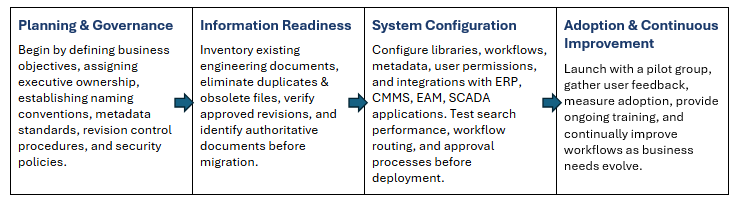
Successful implementations are usually led by a cross-functional team including Engineering, IT, Document Control, Operations, and an executive sponsor.
Implementation Is Just the Beginning
An EDMS implementation is not the finish line—it's the foundation for managing engineering information throughout its lifecycle. Organizations that establish strong governance, standardize engineering information, and continuously improve their processes are better positioned to support compliance, improve operational efficiency, reduce engineering risk, and prepare for future initiatives such as Asset Information Lifecycle Management (AILM), digital transformation, and AI.
By approaching implementation strategically rather than simply deploying software, engineering organizations can create a trusted engineering information environment that delivers value long after the initial rollout.
Learn More
Ready to plan your EDMS implementation? Read the Engineering Leaders Guide to Engineering Document Management Systems for Asset-Intensive Operations where you can:
- Download checklists and tips for successfully implementing an EDMS
- Determine how long it takes to implement an EDMS and the associated cost
- Identify the three biggest barriers to EDMS success and how you can overcome them
- Set metrics and quantify the business benefits of a successful EDMS implementation