

An Engineering Document Management System (EDMS) is a formal system or process to create, manage, store, track, and share engineering documents—including but not limited to CAD files, schematics, drawings, revisions, specifications, manuals, and compliance documents. It supports the entire lifecycle of a document—from creation, through revisions, to archival or retirement. It ensures long-term traceability and compliance, even years after a product is released or a project is complete.

Companies most commonly invest in EDMS to reduce errors, avoid risk, eliminate waste, and improve collaboration across teams and disciplines. At the foundation of every project are engineering documents, which are created, edited, approved and archived by engineers, project managers, contractors, the risks can be high if mismanaged. Poor document management can have real-world consequences:
- Rework errors from outdated versions
- Compromised safety or regulatory compliance from unauthorized changes
- Delayed audits, handovers, and timelines from a lack of traceability
- Project delays and cost overruns from disorganized access to information
What is EDMS and Why Is It the Nervous System of Modern Engineering?
Every project runs on data and documents. EDMS keeps them accurate, compliant, and connected across their entire lifecycle.
In asset-intensive industries, EDMS plays a critical role in managing the constant evolution of complex plant and facility assets. As equipment is maintained, upgraded, or replaced—and as facilities are expanded or reconfigured—engineering information must be carefully controlled and traceable. EDMS platforms help organizations document and manage these changes with precision, ensuring regulatory compliance, operational safety, and efficient project execution.
EDMS Usage by Industry with Sample File Types & Customer Examples
| Industry | EDMS Usage | File Types | Example |
| Manufacturing |
Manage and control versioning of CAD drawings, product specifications, packaging, and process documents.
Ensure traceability for audits and compliance (e.g., ISO 9001).
|
CAD files, BOMs, product specifications, work instructions and SOPs, quality control records, and change orders (ECOs/ECNs). | A food manufacturer uses EDMS to track design changes in product lines across different plants. |
| Utilities & Energy |
Manage asset docs: substation layouts, circuit diagrams, and upgrade plans.
Enable fast retrieval during emergency repairs/outages.
|
Network schematics & wiring diagrams, SCADA and control system diagrams, asset specs, as-built drawings, environmental compliance records. | A large New England energy provider saw new efficiencies using EDMS to track document revisions, especially by contractors. Finding the latest document version in real-time saves countless manhours, eliminating costly errors. |
| Pharmaceuticals & Life Sciences | Validate and manage GmP documents across multiple manufacturing facilities to reduce risk and ensure document traceability for CFR 21 Part 11, Annex 11, and others. | Validation protocols and reports (IQ/OQ/PQ), facility as-builts and equipment layouts, change control docs, SOPs, GMP and FDA compliance records, maintenance logs. | A global pharma company required a validated system with version control and the ability to set up workflows for different scenarios like GmP, safety, or engineering. |
| Engineering & Construction |
Centralize design files, calculations, and reports.
Streamline review and approval workflows.
Enable real-time collaboration on large-scale projects.
|
Architectural and structural CAD drawings, 3D BIM models, design calculations, and specifications. | An engineering firm working on a bridge project uses EDMS to maintain synchronized versions of all structural and geotechnical analysis files. |
| Oil & Gas |
Manage complex engineering specs, pipeline diagrams, safety protocols, and maintenance records.
Comply with strict safety and regulatory standards (e.g., OSHA, ISO, EPA).
Provide access to documents for remote field operations.
|
P&IDs, process flow diagrams, equipment data sheets, safety and HAZOP reports, regulatory compliance docs, inspection and maintenance logs. | An NGL facility uses EDMS to provide access to current plant conditions, vendor documentation, installation and operating manuals—all by searching the equipment tag number. |
| Chemicals |
Fast access to as-built and capital plant documentation for engineering projects happening parallel.
Keep teams in sync with a centralized platform that increases efficiency, improves safety, protects IP, accelerates projects, and streamlines compliance.
|
CAD models and 2D drawings, supplier documentation and specifications. | A chemical company manages $1B of IP assets and supports thousands of users across the globe. |
| Mining | Require centralized project engineering and operations documents in a secure system to improve safety, compliance, reliability, and cost efficiency. | Engineering files, safety and compliance records, project docs, and geological data—CAD drawings and protocols to contracts, budgets, maps, and drilling logs. | A mining company uses an EDMS to manage and track every drawing or a plant site including every wire, every piece of concrete, and even radioactive sources at all locations. |
Why Does EDMS Matter More Than Ever?
The foundation for efficiency, safety, compliance, and digital transformation in every technical organization, and EDMS is crucial to a team's productivity, a project's risk, and long-term success in technical and engineering-focused industries. An EDMS like Adept is foundational to:
- Project efficiency by keeping teams aligned on current documents
- Error reduction by eliminating outdated or misfiled information
- Regulatory compliance through audit trails and approvals
- Cost savings by reducing rework and search time
How to Build a High-Performance EDMS: Proven Best Practices
Standardize, secure, train and integrate—the essential steps to get your system working right from day one:
- Define standardization for drawings, documents, templates, naming, etc. to improve searchability and reduce duplicate or misplaced files.
- Create a check-in/check-out process with formal controls to protect sensitive information and enforce data integrity.
- Set up workflows to streamline processes and reduce manual errors; maintain an audit trail for changes.
- Regularly back up and secure documents to maintain data accuracy, compliance, and performance over time.
- Train teams on workflows and tools including how to access and update documents properly.
- Integrate with 3rd party software to promote seamless storage and retrieval of all engineering documents.
Keep this list in mind as you implement EDMS and make sure you communicate these details to your vendor. Thankfully, Adept comes with a proven blueprint and expert implementation team that will guide you step by step through these best practices.
Why Choose Adept: Built-In Expertise for Every Engineering Team
Adept simplifies setup, automates best practices, and gives your teams the tools to do their best work faster. It provides a sequence with guardrails and tools that promote the natural adoption of EDM best practices. Instead of dictating exact steps, Adept offers:
-
- Templates and standardized best practices—sample folder structures, naming conventions, workflows, etc.—striking a balance between structure and flexibility
- Predefined workflows with prompts that give users control and flexibility while aligning them with good practices
- Governance features like role-based access, automated reviews and approvals, and auditable history for traceability
- Embedded help that gives users tips and instructions to learn on the go.
- Tools for managing as-builts, controlling revisions, onboarding vendors or contractors, etc.
- Systems for integrating EDMS with existing tools (CAD, ERP, etc.)
What Defines a Great EDMS—and How Adept Delivers It
When choosing an EDMS, these are the features you should look for:
- Version and Access Control: Ensures teams always work from the most current version and maintains a history of changes, tracking every revision to a document.
- Approval Workflows: Facilitates formal review, markups and sign-off processes to prevent premature release of unapproved documents, drawings, etc.
- Metadata Tagging: Improves searchability and time to locate information by categorizing documents by project, components, client, discipline, date, etc.
- Role-Based Access: Restricts access to sensitive documents based on roles: engineers, contractors, and maintenance to prevent unauthorized changes.
- Fast Search & Retrieval: Advanced search capabilities enable teams to locate the right document quickly via filtering by metadata, project, or keywords
- Integration with CAD and Enterprise Business Systems: Works seamlessly with AutoCAD, Inventor, SolidWorks, CMMS, GIS and ERP software for harmonized data between systems.
How Dow Turned Document Management into a Competitive Advantage
By implementing Adept, Dow transformed collaboration, compliance, and efficiency—saving time, money, and reducing risk.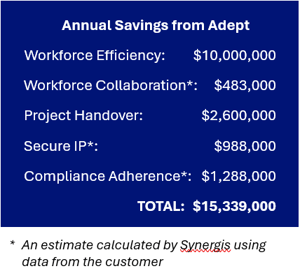
Dow is a multinational corporation that manufactures and sells a wide variety of chemicals, plastics, performance materials, and agricultural solutions. With a corporate commitment to operational excellence, the EDMS team leaders took time to calculate the savings they received due to their Adept implementation:
- Workforce Efficiency: Easily access and control engineering documents
- Workforce Collaboration: Promote document collaboration and worksharing*
- Project Handover: Accelerate post-project data handover from months to weeks.
- Secure Intellectual Property: Safeguard IP and minimize the risks of cyber threats*
- Compliance Adherence: Avoid regulatory compliance risk and Adept’s contribution towards compliance investment*
To learn more, watch the Dow Chemical’s Best Practices to Plan, Deploy, and Measure Global Engineering Information Management webinar.
How Does EDMS Form the Foundation of Digital Transformation?
More than document control, EDMS is the digital foundation connecting data, people and systems for Industry 4.0. Effective management of engineering documents plays a pivotal role in digital transformation by acting as both a foundation and catalyst for modernization in engineering-driven industries. This digitization:
- Centralizes critical information, replacing fragmented systems and paper-based workflows with a unified, accessible repository.
- Ensures that all stakeholders—engineers, contractors, and project managers—can access accurate, real-time information, reduce errors and improve coordination.
- Enables automated workflows for document review, approval, and change management, accelerating project timelines and minimizing administrative overhead.
- Maintains complete audit trails and version histories via regulatory compliance and traceability, which are essential for quality assurance and risk reduction.
- Integrates with enterprise systems such as CAD, PLM, ERP, GIS, Project Planning and CMMS ensures seamless data flow across the project lifecycle, creating a digital thread that enhances decision-making and operational efficiency. Furthermore, EDMS supports remote work environments by providing secure, cloud-based access, making it an essential tool for today’s distributed teams.
- Lays the groundwork for good data to advance technologies (like AI, cloud, and digital twins) and Industry 4.0 to ensure