

Industrial organizations invest millions in improving the performance of their physical assets—modernizing equipment, optimizing maintenance programs, and implementing new digital technologies. Yet one of the most valuable assets is often overlooked: engineering information.
Engineering information, including drawings, P&IDs, specifications, 3D models, maintenance records, inspection reports, and operating procedures, contain the knowledge needed to safely design, operate, maintain, and improve physical assets throughout their lifecycle. When this information is accurate, accessible, and connected, it becomes a strategic business asset. When it isn't, organizations face delays, rework, higher costs, compliance issues, and increased operational risk.
Engineering Information Management (EIM) is the discipline of organizing, governing, connecting, and maintaining engineering documents and technical information throughout the lifecycle of physical assets, ensuring the people responsible for those assets can find and trust the information they need.

What is Engineering Information?
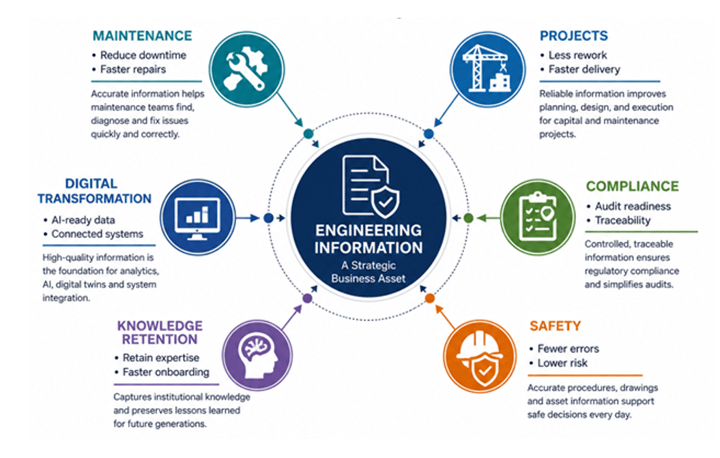
Physical assets don't operate in isolation—they rely on people making informed decisions. Whether an engineer is designing a plant modification, a technician is troubleshooting equipment, or an operator is following a maintenance procedure, everyone depends on trusted engineering information. Every drawing, specification, and procedure tells part of an asset's story. Collectively, they represent decades of engineering knowledge and operational experience.
Organizations that treat engineering information as a business asset, not simply a collection of files, are better equipped to make informed decisions, preserve institutional knowledge, manage change, and respond confidently when issues arise.
Why Engineering Information is Often Siloed
Information is Scattered Across Systems and Teams
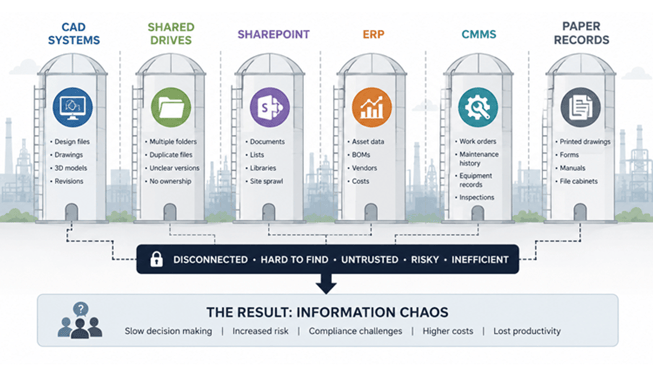
Engineering information is often scattered across shared drives, paper records, email, legacy systems, CAD vaults, ERP platforms, and maintenance applications. These disconnected repositories make it difficult to locate, trust, and share critical information across the organization. When information is scattered, the consequences are significant:
- Engineers waste valuable time searching for documents.
- Maintenance teams unknowingly work from outdated drawings.
- Project teams duplicate effort and experience unnecessary rework.
- Contractors receive inconsistent documentation.
- Compliance teams struggle to demonstrate document control during audits.
When employees can't trust the information they're using, productivity slows and risk increases.
Engineering information management benefits every team that relies on technical information including engineering, maintenance, operations, capital projects, contractors, and regulatory compliance.
Information Becomes Disconnected Across the Asset Lifecycle
The problem isn't limited to where information is stored; it can lose continuity as an asset moves throughout its lifecycle. Engineering information shouldn't remain static after a project is complete. It should evolve alongside the physical asset from design and construction through commissioning, operations, maintenance, and future plant modifications. Each phase should build upon the verified information created during the previous phase, ensuring the organization maintains an accurate and complete record.
What Does Effective Engineering Information Look Like?
Effective engineering information management keeps technical information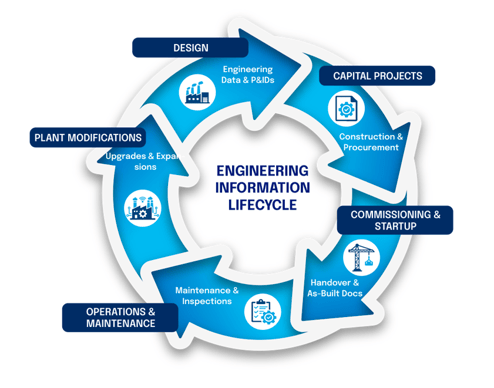
- Accessible, so employees can quickly locate what they need.
- Governed through controlled workflows, approvals, and audit trails.
- Trusted with accurate version control and document integrity.
- Connected across departments, systems, and business processes.
Rather than existing in isolated repositories and lifecycle phases, engineering information becomes a shared source of truth that supports engineering, maintenance, operations, capital projects, and regulatory compliance.
Engineering Document Management System for EIM
An engineering document management system (EDMS) provides the foundation for effective engineering information management. Unlike general document repositories, an EDMS is purpose-built for engineering environments. It centralizes engineering drawings, CAD files, specifications, and technical documentation while providing version control, workflow automation, role-based security, audit trails, and engineering-specific file relationship management.
An EDMS enables teams across the organization to collaborate using the latest approved information while maintaining complete traceability throughout the document lifecycle.
Delivering Measurable Business Value
Engineering information management delivers benefits well beyond the engineering department. Engineering teams improve productivity through better collaboration and fewer design errors. operations personnel gain faster access to accurate documentation, improving safety and reducing downtime. Maintenance technicians spend less time searching for information and more time performing productive work. Capital project teams gain greater control over document reviews, approvals, and project deliverables. Compliance teams benefit from stronger governance and audit readiness.
Organizations that implement an EDMS like Synergis Adept commonly experience
- 30-60% faster document retrieval
- 20-30% less engineering rework
- 30% fewer maintenance delays caused by documentation issues
- Up to 70% fewer document-related audit findings
- Higher workforce productivity
- Improved equipment uptime and faster project startup
These improvements translate directly into lower operating costs, better decision-making, and more reliable operations.
Why Engineering Information is the Foundation for Digital Transformation
Engineering information management is about more than document control. It establishes the trusted information foundation required for digital transformation. Initiatives like predictive maintenance, digital twins, advanced analytics, and artificial intelligence all depend on accurate, governed engineering information. Without trusted data, even the most advanced technologies struggle to deliver meaningful business value.
Organizations that invest in engineering information management today are better positioned to integrate systems, improve lifecycle governance, and leverage emerging technologies tomorrow.
The Bottom Line
More than simple documentation, engineering information is the knowledge that enables organizations to safely design, operate, maintain, and improve their physical assets. By treating engineering information as a governed business asset rather than a collection of disconnected files, organizations improve collaboration, reduce risk, increase operational efficiency, and create the trusted data foundation needed for future digital initiatives. Before you can transform your operations, you must first trust the information that describes them.
To learn more, download The Engineering Leader's Guide to Engineering Document Management Systems for Asset-Intensive Industries: